 Built by our founder
Your own mapping robot
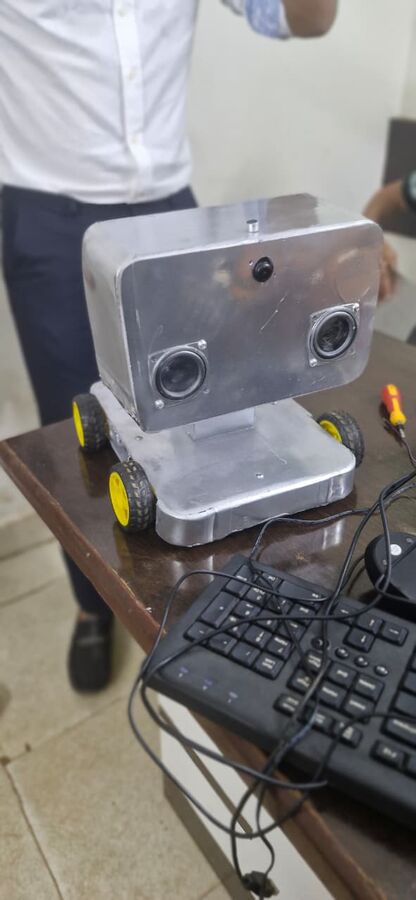
Built in pairs from a Raspberry Pi 5, an ESP32 and a lidar. It maps a room and drives itself to any point you pick.
120 hours of hands-on robotics for B.E./B.Tech students and fresh graduates. Learn the maths, build your own robot, specialise in ROS 2 or embedded systems, and finish with a portfolio recruiters can check.
No payment needed. Batch dates go to the early-access list first.
Every student leaves with three working projects on GitHub, each with a demo video.
Built by our founderBuilt in pairs from a Raspberry Pi 5, an ESP32 and a lidar. It maps a room and drives itself to any point you pick.
 Built by our founder
Robotics Software: a robot that drives to a station and picks up an object with a robot arm.
Embedded Robotics: your own motor controller on STM32, talking to the robot over CAN bus.
A team project built around a real industry problem, presented on Demo Day.
Robotics teams test arm code in Gazebo before it goes near real hardware. You'll do the same in Module 5 and the Robotics Software track.
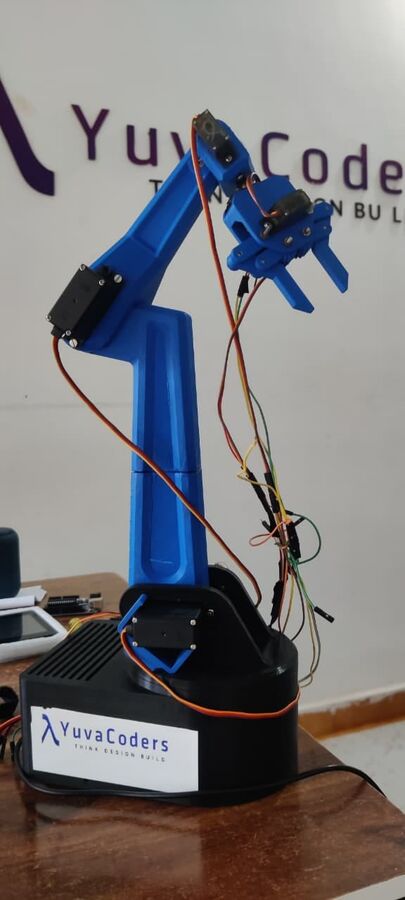
A collaborative robot arm picks up small blocks and places them in bins. Motion planning and pick-and-place are core topics in the Robotics Software track.
The arm replays a task recorded with a web joystick. When a person comes within 1 metre, the replay stops. Safety checks like this are everyday work for integration and test engineers.
For admitted students new to programming: Python, Linux and C basics over 3 weekends.
Linear algebra, transforms, calculus and Jacobians, differential equations, control maths, probability and optimisation. Taught in Python, with a robot example in every class.
Python and C++ for robots, ESP32, motors and PID control, kinematics, ROS 2, sensors, simulation and mapping. Ends with your robot's demo.
Robotics Software (ROS 2, navigation, motion planning, robot arms) or Embedded Robotics (STM32, FreeRTOS, motor control, CAN bus).
Team project, Demo Day and a final technical interview.
Each track runs when at least 5 students choose it.
A robot that drives to a station and picks up an object with a robot arm.
Classes run Saturday and Sunday, 2.5 hours each. Plan 2–3 hours of practice at home every week.
For list members. Valid until 14 days after admissions open.
Pay in 2 parts: 50% at admission, 50% before your track starts (weekend 13).
A laptop (8 GB RAM minimum, 16 GB better)
We studied the curricula of 30 robotics master's programmes, including Carnegie Mellon, Michigan, Georgia Tech, ETH Zurich, TU Delft, NUS and IISc Bengaluru. They all start with the same foundations: maths, kinematics, control, sensing and robot software. This course is built on those foundations, sized for weekends.
YuvaCoders is not affiliated with these universities. This is an industry certificate programme, not a degree.
Vectors and matrices, least squares, rotation matrices and transforms, derivatives and Jacobians, differential equations and Laplace, transfer functions and stability, probability and the Kalman filter, optimisation.
Python for sensor data, C++ and CMake, Git and pull requests.
ESP32, sensors over I2C, motors and encoders, PID speed control.
Arm kinematics on a real robot arm, mobile robot odometry, position control.
Nodes, topics, services and actions, robot description files (URDF, TF2), Gazebo simulation, lidar and IMU, micro-ROS, sensor fusion.
Assemble your robot, map a room with SLAM, navigate with Nav2, fix real faults in the field.
C++ ROS 2 code, A* and RRT path planning, Nav2 tuning, behaviour trees, MoveIt 2, camera-guided pick-and-place, automated testing.
STM32, timers and DMA, sensor drivers, FreeRTOS, real-time control, BLDC motor control, CAN bus, micro-ROS, embedded Linux, hardware debugging.
Requirements, design review, build sprints, testing, Demo Day, final interview.
Each track runs when at least 5 students choose it.
India has 9,000+ open roles in robotics, autonomous systems and industrial AI (Source: Xpheno, July 2026). Most robotics companies are based in Bengaluru, Pune, Chennai, Hyderabad and Delhi NCR, so be open to moving.
We don't promise jobs. We build the skills and the proof companies hire for, and we help you get in front of them.
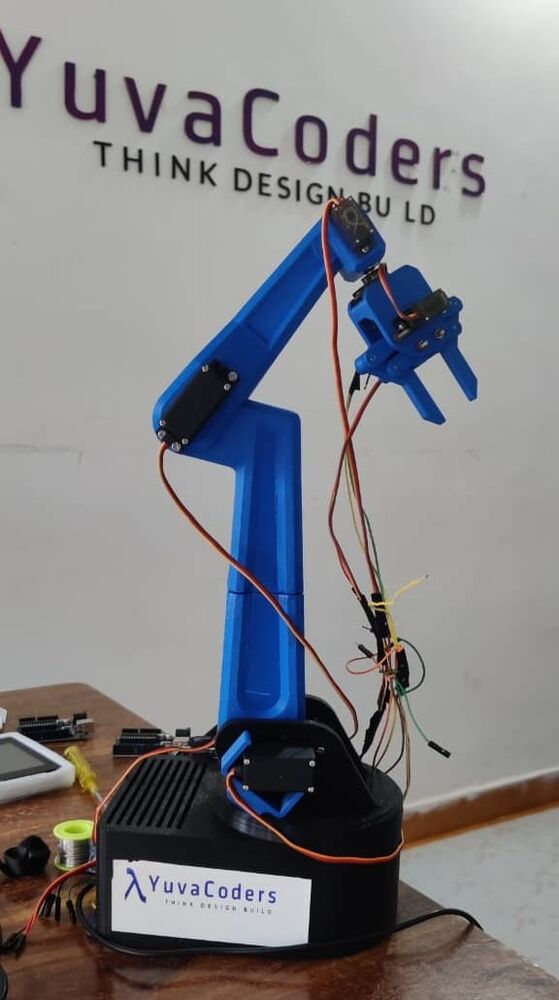
Arif has 6+ years of experience across software, AI and embedded systems. He worked as a consultant at Birlasoft on network and IT solution delivery, then taught coding and computer hardware as a Technical Trainer at NIELIT Goa from 2021 to 2023. He holds a B.Tech in Computer Science and completed the Product Management programme from Duke Corporate Education. Today he runs YuvaCoders and Danitum Technologies, where he is building a collaborative robot arm.
B.E./B.Tech students in any year and branch, fresh graduates and early-career professionals. Minimum age 18.
Yes. If the entry test shows you need it, you take our free 15-hour Bridge course before the batch starts.
Yes, a short programming test in Python or C. It makes sure everyone starts at the same level.
8 GB RAM (16 GB is better) and 50 GB of free space. We help you install Ubuntu and ROS 2.
No. All robot kits, arms, boards, lidars and cameras are provided in the lab.
Classes are on weekends in Goa. Batch dates and the centre location go to the early-access list first.
Each batch keeps spare weekends for exams, festivals and make-up classes. You need at least 75% attendance for the certificate.
No. It's an industry certificate programme.
Weekly maths problem sets, module quizzes, three portfolio projects and a final technical interview. Pass at 60%, Distinction at 80%, with at least 75% attendance.
The new GATE 2027 Robotics & Automation paper overlaps with our maths, kinematics, sensors, embedded and control topics. This isn't GATE coaching, but it covers a good part of that syllabus.
You get 120 hours of hands-on lab work on professional robot hardware, in batches of 12, plus three projects your child can show any employer. That's about ₹500 per hour of teaching.
No, and be careful of anyone who does. We commit to the teaching, the projects and 12 months of placement support.
Message us on WhatsApp any time. We'll share attendance, quiz scores and project progress.
Yes, in 2 parts: 50% at admission and 50% before the track starts.
Join the early-access list. No payment now.